
The First Burn: Finding Your Place on the Fireline
This excerpt is from Chapter Five: The First Burn.
by: River Selby
A pilot flying over us would have seen what looked like a necklace of glinting red beads bordering the brown dirt road, each burner a bead, three surrounded by brush and white grass, plus me, straddling the side of the road and our burn area.
Phillip’s truck was ahead of the crew; Nickolas and David were trailing us in the buggies. If anything went wrong, we’d jump into the buggies and head back down the road. I had unanswered questions (What if the other side of the road caught fire? What if the winds shifted and increased suddenly?) but didn’t dare ask them. That was above my pay grade.
Jason started seesawing his torch up and down, releasing and pausing, assessing the fuel’s flammability. How fast did the oak leaves catch? And the grasses? What about the thick stands of chaparral? The fire’s behavior dictated how fast we burned, and how much fire we needed. Too much fuel and we’d lose it. Not enough and the main fire would keep burning and jump the road. Slowly, almost timidly, Jason started moving ahead, metering out bursts of fire, making sure everything burned hot enough, but not too hot. Flames bloomed behind him as he walked.
A shimmering veil of rising heat warped the air until it resembled distorted glass. Daniel started his own fire, then Gunnar. Jason’s smoke billowed towards the main fire. Daniel’s fire blew into Jason’s. Once Gunnar was fifteen feet ahead of me, I glanced at Jonah. He nodded once, decisively. Time for me to start. This singular purpose, and the risk involved, narrowed my concentration in a way I’d never experienced.
I poured flames into the grass, imprinting perfectly round black coins whose edges immediately overflowed and distorted like dynamic Rorschach blots. Trembling flames leapt across the grasses and climbed up into the brush. Grass, a fine fuel, dries quickly and can catch fire easily. Brush typically takes longer unless its leaves are coated in flammable oils, like chaparral and poison oak. Anything burning underneath something, or burning uphill, preheats the fuel above, increasing flammability. The land sloped uphill from me, so I walked slowly, laying down short lines of fire, staying well behind Gunnar. Stands of oak and chaparral hissed and whooshed into flame-bodies, flushing my cheeks.
A strong gust of wind coaxed my fire towards Gunnar’s. The wind paused and the fire stopped short, momentarily righting itself before another gust blew it into Gunnar’s fire, like a strong exhale. For all the years I worked in fire, I would observe this rhythm, so much like my own breathing. The fire was seeking oxygen. It seemed to breathe like any other animal, popping, whistling, crackling, and sighing. Jason yelled from the inside that it was getting hot. Gunnar struggled to keep up. Now I understood his anger—my spot on the road’s shoulder was free from obstacles and easier to navigate.
“Speed up!” Jonah yelled. We jogged, the fire’s hot breath at our backs. Behind us it consumed the canopy of brush and oak trees, pulsing out ribbons of black smoke with its swirling orange fingers. This was more action than I’d seen in two years on the contract crew. Now I knew why no one had announced an official escape route or safety zone: Everything was perfect. Phillip’s voice came over the crew radio channel: “Let’s see if that gets air attack’s attention!” He wanted slurry—a red gooey mixture of nitrate fertilizer, ammonia, and water often dropped from large tankers and helicopters to prevent the fire from establishing in the green. When the retardant’s moisture dissolves, salts in the fertilizers dry to a fine powder capable of slowing the fire’s progression.
In many ways a wildfire is like an animal running from a predator, swerving unpredictably with changes in wind, fuel type, and/or topography. The fire’s head is like its front legs; its flanks, usually less volatile, run parallel to the head; but if the wind shifts a fire’s flank can easily become the head, driving the fire in a new direction. This happens sometimes without warning. Phillip wanted slurry on the main fire’s flanks because the wind would shift with early evening cooling. Get control of the flanks, and the head of the fire would have a harder time shifting with the wind. Instead, it would run into our burn and flicker out. One load of slurry can cost over two thousand dollars.
My gear bounced on my hips as I jogged. When my drip torch ran out Jonah handed me a new one and I squeezed my hip belt as tight as I could, no longer worried about my appearance. “Want to switch out?” Jonah asked, gesturing to everyone on the road. I shook my head and grinned. If I wanted to get stronger, this was the way to do it, I thought, surprised that I was holding pace with the guys. When my torch emptied again it was almost dark. Max replaced Gunnar. Jonah gave me another torch. After another hour or so we all switched with David’s squad.
This may have been the exact moment I fell in love with being a hotshot. Burning was like entering an alternate dimension. My shirt was drenched but I hadn’t noticed myself sweating. The drip torch became an extension of my arm, fire a liquid expelled by my body. There was no pain. I’d been totally focused, consumed like branches alchemized from solid to smoke. I was cleansed.
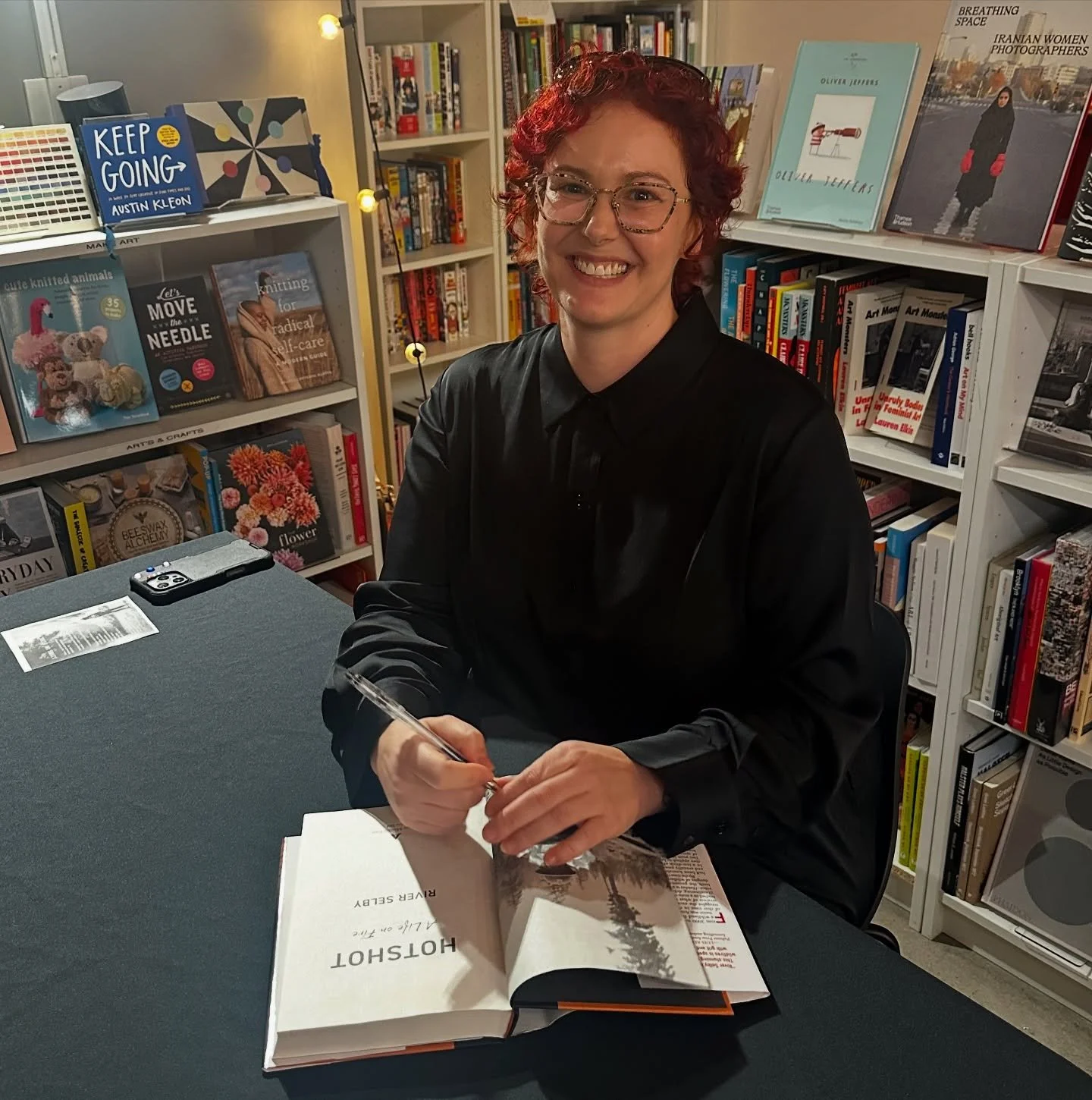
River Selby worked as a wildland firefighter for seven years, stationed out of California, Oregon, Colorado, and Alaska. They are the author of Hotshot: A Life on Fire, named a Kirkus Best Nonfiction Book of the Year and winner of the Ensley Developing Writer Award.
River was born in Los Angeles and grew up in the Pacific Northwest. They are a first generation high-school and college graduate. They are pursuing their PhD in Nonfiction with an emphasis in postcolonialism, North American colonization, archival studies, and post 20th Century literature and culture. They are currently working on their second book.
Purchase River’s book on Amazon here.
Excerpted from Hotshot © 2025 by River Selby. Reprinted with the permission of the publisher, Atlantic Monthly Press, an imprint of Grove Atlantic, Inc. All rights reserved.